Sixth Street is a National Register historic district in Austin, with six blocks of turn-of-the-century Victorian commercial buildings. Long before it became the Live Music Capital of the World®, the area (formerly known as Pecan Street) served as Austin's primary cultural hub. It was a melting pot where European, Middle Eastern, Asian and African American entrepreneurs operated small businesses side-by-side.
Today, while the neon lights and rocking music scene keep the district vibrant, the original limestone walls and ornate facades tell a deeper story of the people who built the city's economy. Visitors can explore these legendary sites to see where Austin's social and commercial history intertwines.
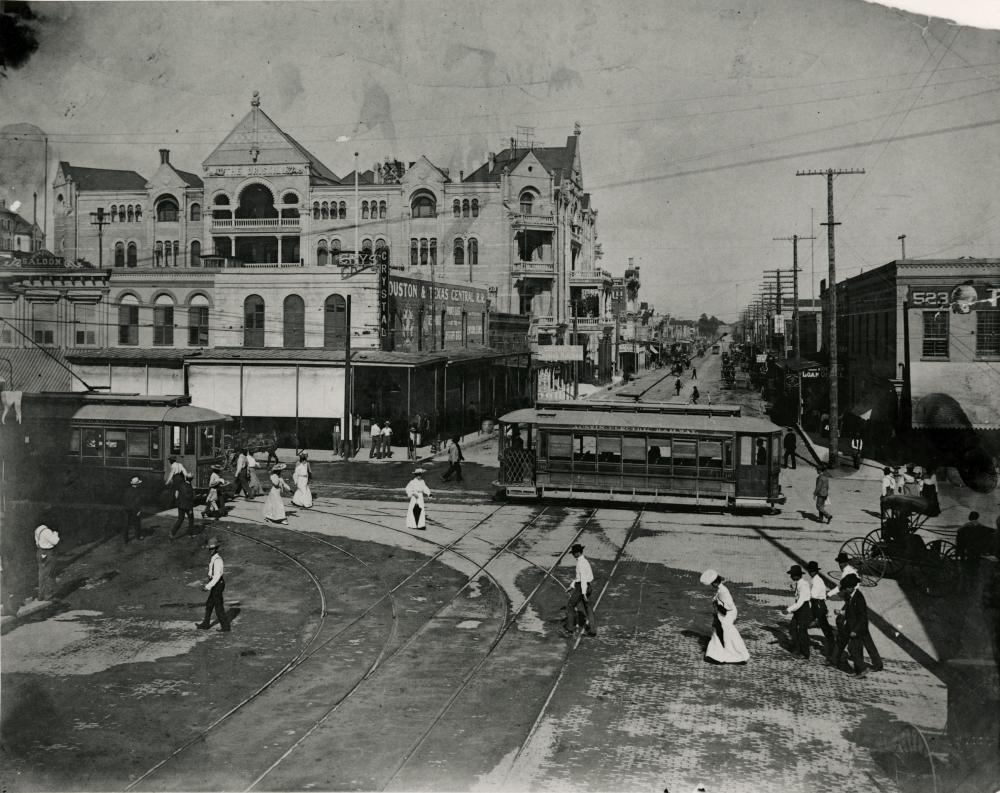
Historic Sixth Street and the Driskill Hotel. C00146, Austin History Center, Austin Public Library.
Historic Sixth Street (Pecan Street)
Walking the 500-700 blocks of East Sixth Street reveals the storied roots of Austin's business community. What is now Pete's Dueling Piano Bar was once a carriage shop operated by Italian immigrant Michael Paggi from 1875 to 1905. Former enslaved person E. H. Carrington, followed by son-in-law D. H. Lyons, owned a successful grocery from 1873 into the 1940s just across the street from modern day Esther's Follies.
The Driskill Hotel
Since opening its doors in 1886, cattleman Jesse Driskill’s opulent hotel has provided an elegant backdrop for gatherings of the powerful, the famous and the sociable. Designed by J. N. Preston in the Romanesque style, the building features detailed portrait busts of Driskill and his sons on the facade. THe hotel as hbeen witness to much history for over 140 years, hosting inaugruals balls for Texas governors and serving as a "second home" to President Lyndon B. Johnnson.
Susanna Dickinson Museum
Located in Brush Square, this 1869 limestonehouse was the home of Alamo survivor Susanna Dickinson and her husband Joseph Hannig. As one of the few survivors of the Battle of the Alamo, Dickinson is a central figure in Texas history. The museum preserves her legacy and offers a glimpse into the life of 19th-century Austin.
O. Henry Museum
This 1886 Victorian cottage once once the residence of William Sydney Porter, better known by his pen name, O. Henry. The famed short-story writer lived here while working as a pharmacist and draftsman. The museum houses a collection of his personal effects and hosts the annual Pun-Off World Championships, celebrating the authors legendary wit and wordplay.
Midnight Cowboy
While many know it today as an intimate speakeasy, this building's history is a window into Sixth Street in the mid-20th centruy. For decades, it operated as one of the city's most notorious brothels. While the business was famously shuttered in a 2011 raid, the new tenents chose to keep the original handpainted sign and "buzzer for entry" system as a cheeky nod to the buildin's colorful and ilicit history.
The Ritz Theater (Comedy Mothership)
An anchor of the district since the 1920s, The Ritz was the first theater in Austin built specifically for "talkies." Throughout it's century of existence, the building has served as a mirror of Austin culture, transforming from a movie palace to a high-energy punk and rock venue in the 1970s and 80s, to later becoming home to a top comedy theater in the city. It's classic marquee remains and iconic visual landmark in the city.
More East Sixth Historic Sites
Brush Square
One of the four original public squares for Edwin Waller's 1839 plan for Austin, Brush Square once served as a bustling community market, and now houses two of the citie's favorite small museums.
The Randerson-Lundell Building
701 E. Sixth Street
Starting around 1921, Ben Garza and his brothers operated a meat market here for many years, serving as a hub for the local Latino community.
The Hannig Building
200 E. Sixth Street
Built in 1875 by Joseph Hannig (Susannah Dickinson's husband), this building is a classic example of the Victorian commercial architecture that defines the district.
Ready for another history lesson? Hop on a historic downtown walking tour at the Austin Visitor Center or check out other significant and storied places by visiting our History page.