Ready to explore "The Forty Acres"? Located in Central Austin, The University of Texas at Austin is home to historic landmarks, public art, and world-class cultural institutions. Whether you are a prospective student, visiting family, or a traveler wanting to take in the sight of the iconic UT Tower and Darrell K Royal - Texas Memorial Stadium, exploring campus on foot is the best way to experience it. Use this step-by-step self-guided walking tour and map to navigate the core campus landmarks on your own schedule.
Visitor Tip: Pay-to-park garages like the Brazos Garage (210 E. 18th St.) or San Jacinto Garage (2401 San Jacinto Blvd.) offer central access to the starting points along the South Mall and Main Building.
 UT Tower and Littlefield Fountain. Credit Erin Newman-Mitchell.
Stop 1: UT Tower & Campus Mall
110 Inner Campus Dr.
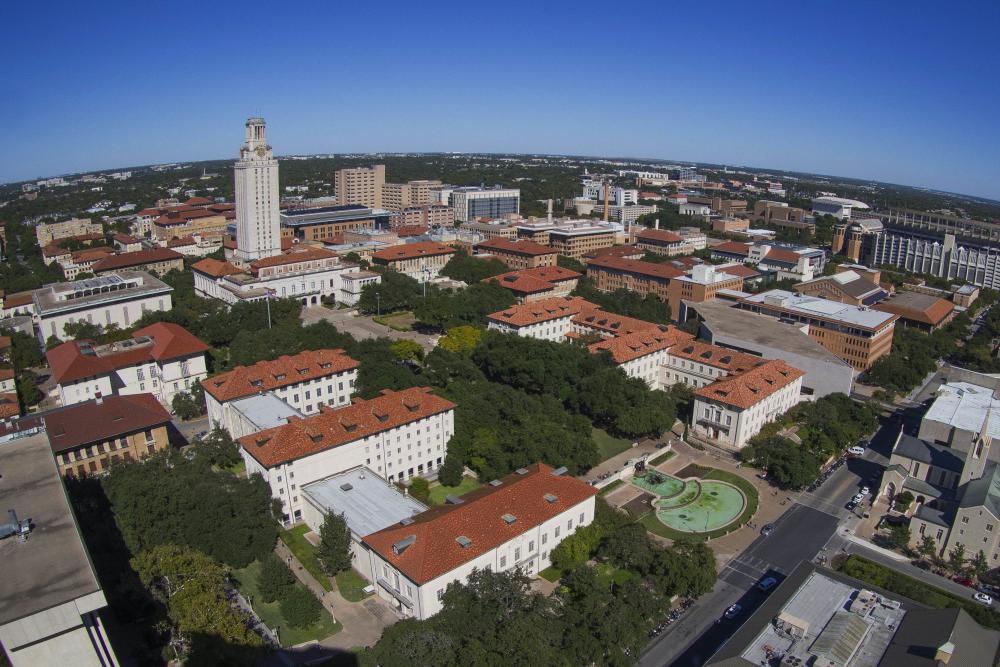
Standing 307 feet tall, the UT Tower (Main Building) serves as the iconic heart of campus. Designed by architect Paul Cret, the building offers views looking south down the Main Mall toward the Texas State Capitol.
While public tours of the observation deck are currently paused due to historical restoration work, the Tower remains a focal point for campus traditions. Check the building at night: after major academic achievements or University of Texas Longhorns athletic victories, the Tower glows burnt orange.
Stop 2: Littlefield Fountain & South Lawn
201 W. 21st St.
Heading south from the Tower across the Main Mall brings you to Littlefield Fountain. Unveiled in 1933, this monumental bronze fountain was sculpted by Italian artist Pompeo Coppini to commemorate University of Texas students and alumni who served in World War I. Frame your photos here looking north toward the Tower, or turn south for an unobstructed view down University Avenue to the Texas State Capitol.
Stop 3: Harry Ransom Center
300 W 21st St.
Located just west of Littlefield Fountain, the Harry Ransom Center is a humanities research library and museum. Admission is free, making it an essential stop to view cultural artifacts up close. Permanent exhibits include the Gutenberg Bible (one of only 21 complete copies on vellum in the world) and the Niépce Heliograph, recognized as the world's earliest surviving photograph.
Courtesy of the University of Texas at Austin.
Stop 4: Battle Hall & César Chávez Statue
302 Inner Campus Dr.
Walk northwest toward the West Mall to discover Battle Hall. Built in 1911 and designed by Spanish Renaissance revival architect Cass Gilbert, Battle Hall is listed on the National Register of Historic Places and is widely considered one of the most beautiful buildings in Texas.
Directly adjacent on the West Mall plaza stands the César Chávez Statue. Unveiled in 2007, this bronze sculpture honors the legacy of the civil rights icon and labor leader, marking a pivotal moment in the diversification of campus public art.
Stop 5: Barbara Jordan Statue & Battle Oaks
W. 24th St. & Whitis Ave.
Follow Whitis Avenue one block north to the shade of the historic Battle Oaks—three oak trees that predate the university itself. Here you will find the Barbara Jordan Statue. Dedicated in 2009, this monument honors the pioneering politician, civil rights leader, and former UT professor who was the first Southern African-American woman elected to the U.S. House of Representatives.

Turtle pond. Courtesy of the University of Texas at Austin.
Stop 6: Botany Greenhouse & Turtle Pond
205 W. 24th St.
Tucked directly behind the Biological Laboratories building along 24th Street sits one of the most serene spots on campus: the UT Turtle Pond and Botany Greenhouse. Created in the 1930s, this quiet natural enclave is home to dozens of native turtles, aquatic plants, and research green spaces—offering a peaceful retreat for students and visitors alike.
Stop 7:Texas Science & Natural History Museum
2400 Trinity St.
Head east along 24th Street toward Trinity Street to reach the Texas Science & Natural History Museum. Housed in a historic Art Deco building, the museum showcases the natural wonders of Texas, featuring prehistoric fossils (including native dinosaur discoveries), wildlife exhibits, and interactive displays that highlight scientific discovery across the Lone Star State.
Stop 8: LBJ Library and Museum
2313 Red River St.
Just north of the stadium on the eastern edge of campus sits the LBJ Presidential Library. Situated on a 30-acre complex, the library houses 45 million pages of historical documents from the presidency of Lyndon B. Johnson. Exhibits detail the Civil Rights movement, the Great Society initiatives, and 1960s American culture, complete with an exact 7/8ths-scale replica of the Oval Office as it appeared during Johnson's presidency.
Stop 9: Darrell K Royal - Texas Memorial Stadium
2139 San Jacinto Blvd.
Head northeast past the East Mall toward San Jacinto Boulevard to take in the sheer scale of Darrell K Royal Stadium. Home to University of Texas Longhorns football since 1924, the stadium seats over 100,000 fans on game days. Walk along the west concourse to admire the historic brick exterior and memorial plazas dedicated to Texas veterans.

Courtesy Blanton Museum of Art.
Stop 10: Blanton Museum of Art & Ellsworth Kelly's Austin
200 E. Martin Luther King Jr Blvd.
Cross the East Mall to reach the Blanton Museum of Art, one of the largest university art museums in the country. The museum features an extensive collection of modern and contemporary art, Latin American art, and European Old Master paintings.
Step outside into the revitalized museum grounds, which feature soaring, flower-like shade canopy structures. The courtyard connects the main gallery buildings directly to Austin by artist Ellsworth Kelly. The 2,715-square-foot structure features vibrant stained-glass windows, totem sculptures, and black-and-white marble panels.
Exploring UT Campus
- Estimated Duration: 2.5 to 3.5 hours
- Walking Distance: ~2.5 miles
- Recommended Parking: San Jacinto Garage (SJG) or Brazos Garage (BRG)
After completing your walking loop, take time to explore more of what campus life has to offer. Use our guide to restaurants and music near the University of Texas campus to explore more of the area.